What can AI actually automate for a small business in PEI?
Artificial intelligence is everywhere right now. But if you're running a business in Prince Edward Island, the question isn't whether AI is impressive.
It's what can it actually do for your business?
Can it answer your phones? Handle customer inquiries? Prepare quotes? Take repetitive administrative work off your hands?
Increasingly, the answer is yes.
And you don't need to be a technology company or have a large budget to start exploring these possibilities.
Here are some of the most practical ways small businesses can put AI to work today.
1. AI phone receptionists and voice agents
Imagine you're running a plumbing business in Charlottetown. You're out on a job, your phone rings, and you can't answer.
Instead of the caller reaching voicemail or trying another company, an AI receptionist answers.
It can have a natural conversation, ask what the customer needs, collect their contact information, and potentially schedule an appointment.
Modern AI voice agents can do much more than play prerecorded messages.
Depending on how they're configured, they can:
- Answer business calls during or outside working hours.
- Respond to common questions about services, hours, and locations.
- Collect information from prospective customers.
- Check calendars and book available appointments.
- Route urgent calls to the appropriate person.
- Send staff a summary of the conversation.
For a contractor, that might mean capturing an inquiry while everyone is on-site. For a salon, it could mean handling routine booking requests. For a retailer, it might mean answering questions about opening hours and available services.
The important distinction is that an AI voice agent doesn't just speak. It can connect conversations to the software a business already uses.
Of course, it needs appropriate safeguards. Callers should understand they're speaking with AI, complicated situations need a human fallback, and bookings should be confirmed against real availability.
A well-designed system supports your team rather than pretending to replace every interaction.
2. Customer inquiries and follow-ups
Many small businesses receive inquiries across email, website forms, and social media.
Keeping track of everything can become a job of its own.
AI can help organize those incoming messages, identify what customers are asking for, and prepare the next step.
For example, a contractor's website form could trigger a workflow that:
- Extracts the customer's name, location, and project details.
- Categorizes the inquiry by service type.
- Adds the information to a customer management system.
- Drafts a response requesting any missing information.
- Notifies the appropriate employee.
The result is less manual data entry and a more organized process for handling potential customers.
For pricing, commitments, and unusual requests, a person can review the response before it's sent.
3. Quotes, invoices, and paperwork
Preparing estimates, processing documents, and moving information between systems are common sources of repetitive work.
Consider a renovation company that receives customer requirements through emails, photos, and notes.
An AI-assisted workflow could organize that information and prepare a draft estimate using the company's existing templates and approved pricing data.
Similar systems can help businesses:
- Extract information from invoices and forms.
- Organize receipts and records.
- Prepare standard documents.
- Identify missing paperwork.
- Summarize lengthy documents.
- Transfer approved information between applications.
AI is particularly useful when information arrives in inconsistent formats.
However, financial calculations and approvals should rely on verified data and reliable business rules, not guesses generated by an AI model.
4. Appointment scheduling and operational workflows
Not every useful automation requires artificial intelligence.
Sometimes businesses simply need their existing systems to communicate better.
A salon could automatically send appointment reminders. A service company could notify staff when a job becomes overdue. A retailer could receive alerts when inventory reaches a specified level.
AI becomes useful when the system needs to interpret a request or work with information that isn't neatly structured.
For example, a customer might email:
"Something came up Thursday. Could I move my appointment to Friday afternoon?"
An AI-assisted system could identify the rescheduling request, check connected calendar availability, and prepare an appropriate response.
The actual booking change would follow the business's configured rules and approval requirements.
Done properly, these workflows reduce administrative effort without sacrificing control.
5. Research, reporting, and content preparation
Some organizations spend hours gathering information, monitoring sources, and preparing updates.
This is another area where AI can be particularly useful.
A system can regularly check selected sources, identify relevant developments, summarize information, and prepare drafts for review.
Rather than replacing editorial judgment, it removes much of the repetitive research and preparation.
A real PEI example: PEI Health Coalition
At Avern, we built an AI-assisted editorial workflow for the PEI Health Coalition.
The organization needed an efficient way to monitor relevant health news and prepare website updates.
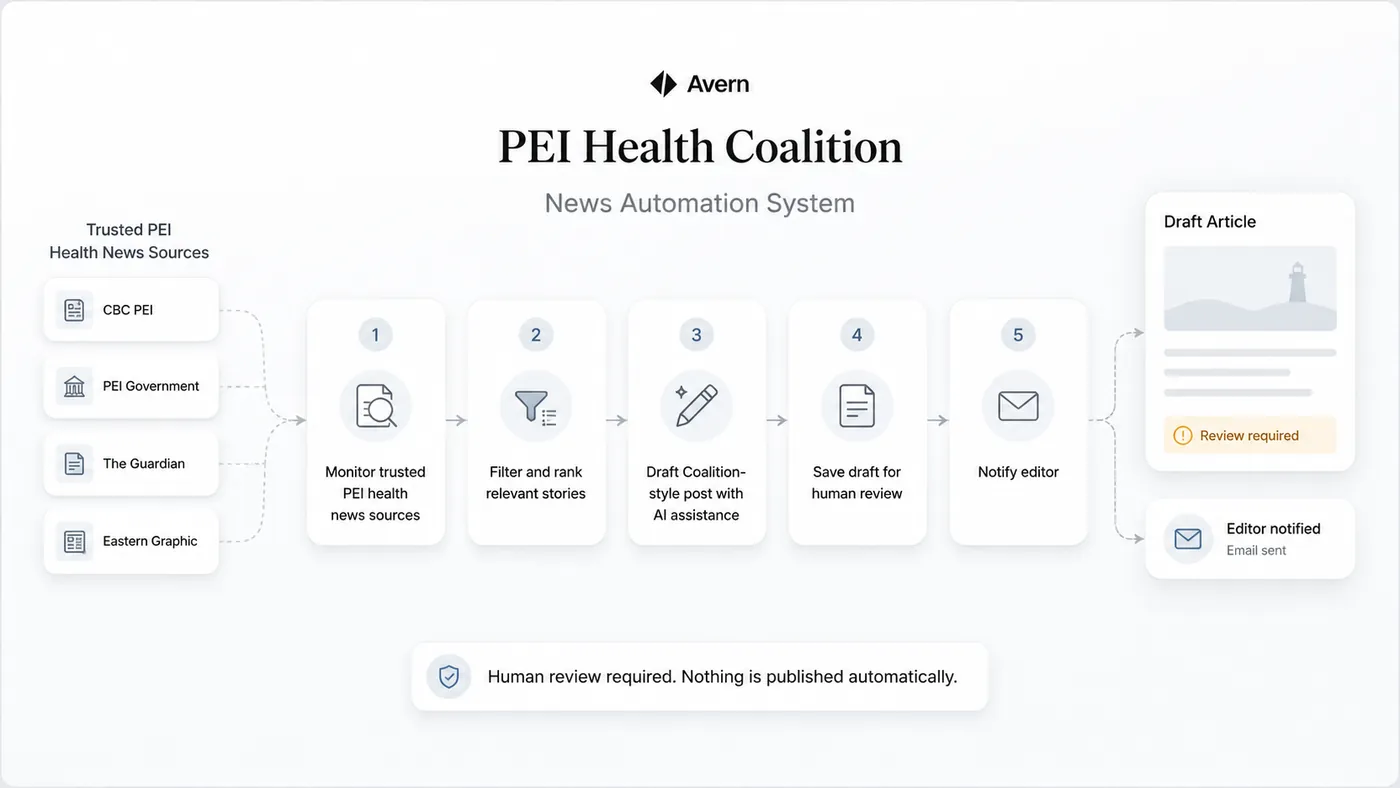
The workflow:
- Checks selected trusted sources on a schedule.
- Identifies relevant stories.
- Filters out duplicates and unsuitable material.
- Prepares article drafts.
- Saves those drafts into the website's content management system.
- Notifies an editor when material is ready for review.
Articles are not published automatically. A human editor makes the final decision.
It's an example of AI working quietly behind the scenes, supporting an organization's existing responsibilities rather than replacing them.
Explore the PEI Health Coalition editorial workflow
6. Internal knowledge and document search
Many businesses have valuable information scattered across PDFs, manuals, spreadsheets, policies, and shared folders.
Finding the right answer can be unnecessarily time-consuming.
AI-powered internal search tools can help employees ask questions in everyday language and retrieve relevant information from approved company documents.
For example:
- "What's our process for handling a returned product?"
- "Which policy applies to this situation?"
- "Where are the requirements for this type of job?"
- "What changed between these two versions of a document?"
A well-built system can include references to the original documents, allowing employees to verify the information instead of trusting an unsupported answer.
This can be particularly useful for organizations managing substantial documentation or complex internal procedures.
What shouldn't you automate?
Not every task should be handed to AI.
These systems can misunderstand requests, produce incorrect information, and encounter situations they weren't designed to handle.
Human oversight remains particularly important for:
- Financial transactions and approvals.
- Sensitive customer or employee information.
- Legal, medical, or safety-related decisions.
- Unusual customer disputes.
- Important public communications.
Businesses also need to consider privacy, consent, and data security before connecting AI systems to phone calls, customer records, or internal documents.
A good automation should have clearly defined responsibilities, appropriate access controls, and a straightforward way for a person to intervene.
The goal is to remove unnecessary work, not remove accountability.
How much does AI automation cost?
There isn't a single price for AI automation.
A simple workflow connecting two existing applications is very different from a custom voice receptionist or an internal system integrating several databases.
Costs generally depend on the complexity of the process, the software involved, the level of reliability required, and how much custom development is necessary.
Some solutions also have ongoing costs for hosting, AI usage, phone minutes, or third-party software.
Before investing, it's worth asking:
How much time does this process currently take, and what would improving it be worth?
A useful automation doesn't need to be especially sophisticated. It needs to deliver enough practical value to justify the investment and maintenance.
For examples and starting prices, read how much AI automation costs for a small business in PEI.
Where should a PEI business start?
Start with the work your team already does.
Look for processes that are repetitive, time-consuming, and relatively predictable.
Perhaps you're missing calls when staff are busy. Maybe someone spends hours every week copying information between systems. Or perhaps preparing routine documents is taking time away from more valuable work.
Choose one problem and understand its current cost.
Then explore whether the right solution is AI, conventional automation, better software, or an improvement to the existing process.
Start with one measurable improvement. Make sure it works. Then build on it.
Bringing practical AI to Prince Edward Island
AI technology is advancing quickly, and the range of things businesses can automate continues to expand.
But taking advantage of it doesn't require chasing every new tool or rebuilding the way your company operates.
Sometimes the best solution is an AI receptionist answering missed calls. Sometimes it's an automated workflow running quietly in the background. Sometimes it's custom software that finally connects processes that have been disconnected for years.
At Avern, we're based in Prince Edward Island and build websites, software, and AI-powered solutions for businesses and organizations across Atlantic Canada.
We focus on understanding how your business operates, identifying opportunities worth pursuing, and building technology that makes everyday work easier.
Have a process that's taking up too much of your time? Start a conversation with Avern and tell us what you're trying to improve. We'll help you explore what's possible and what actually makes sense for your business.